
Why Lean Six Sigma Matters More Than Ever in IT & ITES -PART-1
In today’s hyper-digital world, customers don’t compare your IT service with your competitor’s IT service — they compare it with the best digital experience they’ve ever had. Whether it’s a banking transaction, a mobile app update, a helpdesk response, or a data processing service, expectations for speed, accuracy, and reliability are brutally high.
Yet most IT and IT-enabled services (ITES) teams operate in constant firefighting mode:
- Bugs appear after release
- Tickets pile up in queues
- Customers escalate for delayed responses
- Rework eats into delivery capacity
- Teams feel overwhelmed
This is where Lean Six Sigma (LSS) becomes a game changer.
Originally born in manufacturing, Lean Six Sigma has evolved into a powerful methodology for service excellence and digital operations. When applied correctly, it helps IT and ITES teams:
- Reduce recurring errors
- Speed up delivery cycles
- Improve service consistency
- Lower operational costs
- Build customer trust
Lean Six Sigma is not about bureaucracy or paperwork. It is about building reliable digital processes that scale without chaos.
Why Lean Six Sigma is Perfectly Suited for IT & ITES
IT and ITES deliver intangible services — code, tickets, transactions, reports, analytics, support. Unlike manufacturing, defects are invisible until the customer feels the pain. But the underlying problems are the same:
Common IT & ITES Pain Points
- Coding defects and post-release bugs
- Repeated rework due to unclear requirements
- Delays in approvals and handoffs
- High ticket turnaround time (TAT)
- Inconsistent service quality
- Escalations and customer dissatisfaction
Lean Six Sigma brings structure to chaos by combining:
- Lean→ Speed, waste removal, flow
- Six Sigma→ Accuracy, defect reduction, consistency
Together, they transform IT delivery from reactive firefighting to predictable, high-quality execution.
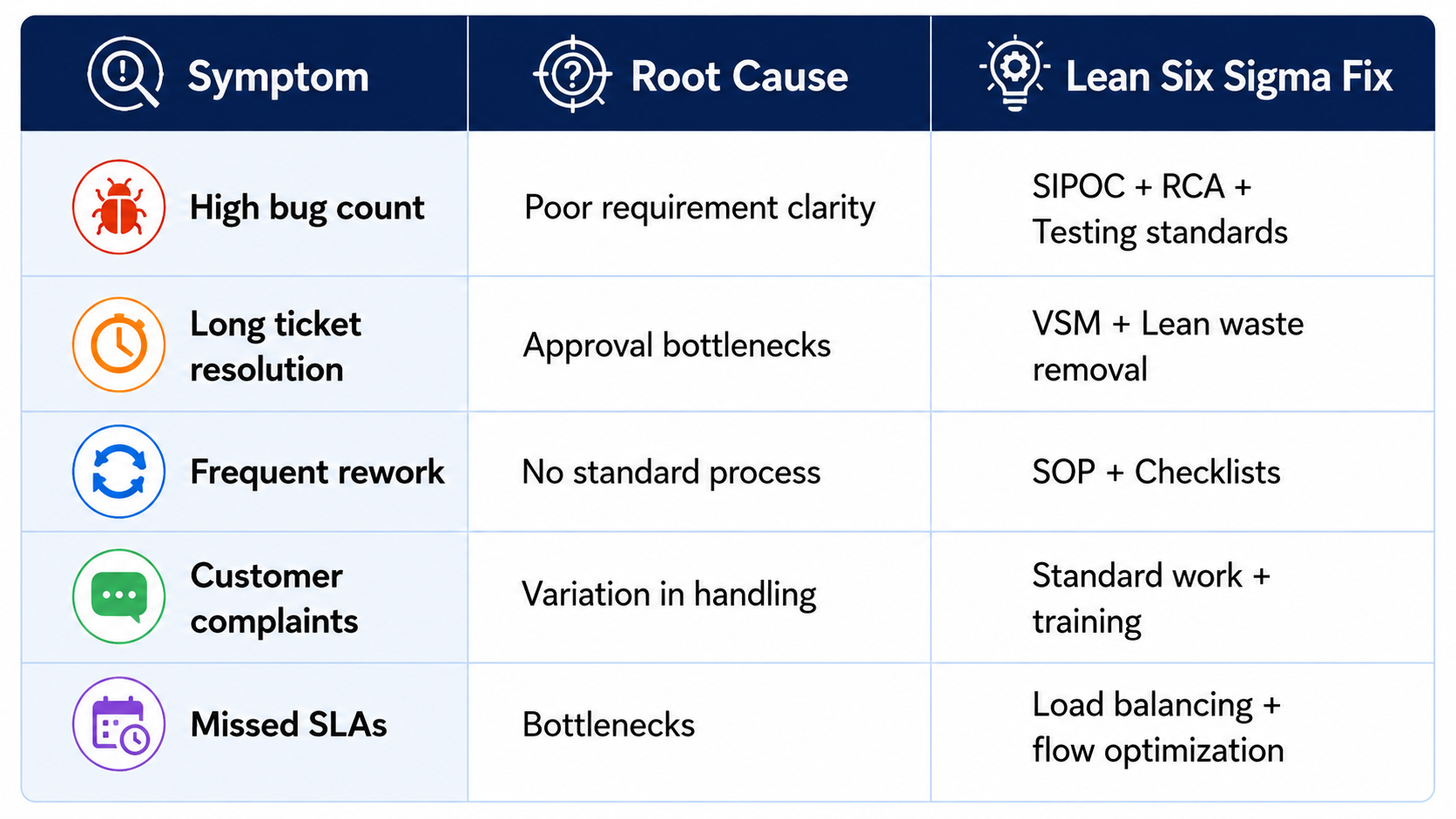
Common Process Challenges in IT & ITES (Root Causes, Not Symptoms)
Most IT teams see symptoms. Lean Six Sigma helps uncover root causes:

Without structured improvement, these problems repeat endlessly — only the pressure changes.
How Lean Six Sigma Reduces Errors in IT & ITES
Errors in IT can mean downtime, data loss, compliance risk, and customer churn. Lean Six Sigma attacks errors scientifically, not emotionally.
🔹 Root Cause Analysis (Fishbone, 5 Whys)
Instead of fixing the same bug repeatedly, teams identify:

This moves problem-solving from opinion-based to evidence-based.
🔹 Process Standardization
Lean Six Sigma builds:

This reduces variation between teams and individuals.
🔹 Defect Measurement

What gets measured gets improved.
🔹 Statistical Monitoring
Control charts and trend analysis help detect when error rates are increasing before customers start escalating.
Example:
A billing support team faces repeated customer complaints. LSS reveals inconsistent data entry rules as the root cause. Standardizing input formats and adding validation checks reduces complaint volume by 40%.


