
Lean Thinking in the Gas Distribution Industry: Driving Safety, Reliability, and Operational Excellence-Part-2
Lean Principles Applied to Gas Distribution
Lean thinking is built around five core principles that guide improvement initiatives.
Identify Customer Value
The first step is understanding what customers truly value.
In gas distribution, customers expect:
- Reliable gas supply
- Safe operations
- Fast service response
- Transparent billing
Any activity that does not contribute to these outcomes should be examined carefully.
Map the Value Stream
Value Stream Mapping involves visualizing the entire process from supply to customer delivery.
This exercise helps organizations identify bottlenecks, delays, and unnecessary steps.
For example, mapping the cylinder distribution process may reveal multiple approvals or documentation steps that slow down delivery operations.
Create Flow
Once waste is identified, processes should be redesigned to create smooth operational flow.
This may involve reorganizing workstations, simplifying procedures, or improving coordination between departments.
Establish Pull Systems
Lean encourages demand-driven operations rather than producing output in anticipation of demand.In gas utilities, this principle can help optimize inventory management and avoid overproduction.
Pursue Continuous Improvement
Lean is not a one-time initiative but a continuous improvement journey.
Organizations must constantly monitor processes and seek opportunities for incremental improvements.
Lean Opportunities in Gas Distribution Operations
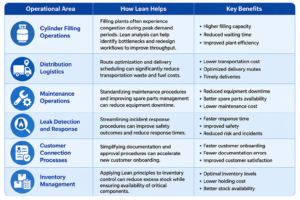
Lean thinking can unlock significant improvement opportunities across various operational areas.
Lean Tools for Gas Utilities
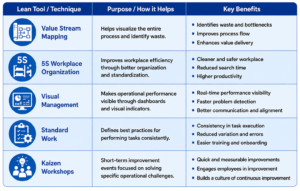
Several practical Lean tools can support improvement initiatives.
Benefits of Lean in the Gas Industry
Organizations that adopt Lean thinking can achieve substantial benefits.
Operational Benefits
- Improved asset utilization
- Faster service delivery
- Reduced operational delays
Financial Benefits
- Lower operating costs
- Reduced inventory carrying costs
- Improved resource utilization
Safety Benefits
Lean processes reduce operational complexity, which contributes to safer operations.
Customer Benefits
Customers benefit from faster service, improved reliability, and consistent service quality.
Building a Lean Culture in Gas Organizations
Sustainable improvement requires more than tools—it requires culture.
Lean organizations encourage employees at all levels to participate in improvement initiatives.
Key elements of a Lean culture include:
- Leadership commitment
- Employee engagement
- Continuous learning
- Data-driven decision making
Training programs play an important role in building this capability across the organization.
How ICEQBS Supports Lean Transformation
ICEQBS helps organizations implement structured process improvement programs that drive measurable results.
Through training, consulting, and hands-on improvement projects, ICEQBS supports organizations in:
- diagnosing operational inefficiencies
- redesigning business processes
- building internal improvement capability
- sustaining continuous improvement programs
By combining practical expertise with industry best practices, ICEQBS helps organizations transform operations and achieve long-term performance excellence.
Conclusion
The gas distribution industry operates in an environment where reliability, safety, and efficiency are paramount. As operational complexity continues to increase, organizations must adopt structured improvement approacwhes to remain competitive and resilient.
Lean thinking offers a powerful framework for identifying inefficiencies, eliminating waste, and improving operational flow. By focusing on value creation and continuous improvement, gas utilities can enhance both operational performance and customer satisfaction.
For organizations seeking to strengthen operational excellence, Lean is not simply a methodology—it is a strategic capability that drives long-term success.