
SIPOC Explained: How to Define Processes and Drive Lean Six Sigma Success-Part-2
H2: SIPOC vs Value Stream Mapping
SIPOC and Value Stream Mapping serve different purposes:

SIPOC is often the starting point, while VSM provides deeper insights.
H2: Why SIPOC Is Still Relevant Today
SIPOC is widely used across industries, including:
- Manufacturing
- IT and services
- Healthcare
- Finance
- Digital transformation
Its simplicity makes it adaptable, while its structure makes it powerful.
H2: Conclusion: Start with Clarity, Then Improve
Many organizations focus on tools, data, and technology. However, true improvement begins with clarity.
SIPOC provides that clarity by:
- Defining process boundaries
- Aligning stakeholders
- Identifying dependencies
- Establishing a strong foundation
Before analyzing or improving any process, take the time to understand it.
Because when the process is clearly defined, improvement becomes prec.ise and effective
Internal Linking Suggestions
- Lean Six Sigma Training page
- DMAIC methodology blog
- Value Stream Mapping blog
Example:
Tools like value stream mapping can be used after SIPOC to analyze process flow in detail.
SEO Checklist (Elementor Ready)
✔ Primary keyword used (SIPOC in Lean Six Sigma)
✔ H1, H2, H3 structured
✔ Short paragraphs
✔ Image placements with ALT text
✔ Internal linking opportunities
✔ Meta title + description included
SIPOC in Lean Six Sigma: The Ultimate Guide to Process Definition and Clarity
In every improvement journey, clarity must come before action. Organizations often rush into data collection, root cause analysis, or solution design without first asking a critical question: What exactly is the process we are trying to improve?
This lack of clarity is one of the most common reasons why improvement projects fail. Teams argue about scope. Stakeholders disagree on boundaries. Data is collected on the wrong areas. Solutions are implemented without alignment.
Lean Six Sigma addresses this risk through a deceptively simple yet extraordinarily powerful tool called the SIPOC diagram.
SIPOC is a high-level process mapping tool used to define and frame a process before improvement begins. Though simple in appearance, SIPOC has the power to align cross-functional teams, clarify scope, and prevent costly project misdirection.
This article provides a comprehensive guide to understanding SIPOC, its strategic importance, how to create one correctly, common mistakes to avoid, real-world applications, and how organizations can leverage it for sustainable improvement.
What Is a SIPOC Diagram?
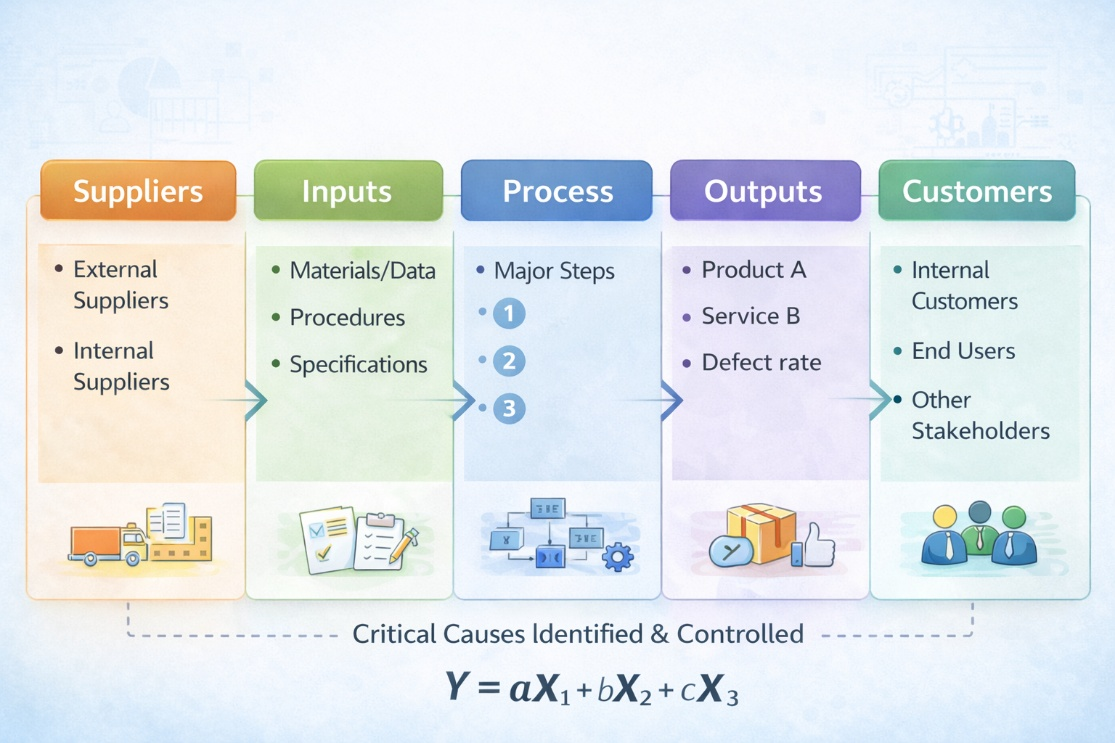
SIPOC is an acronym that stands for Suppliers, Inputs, Process, Outputs, and Customers. It represents a structured view of a process from beginning to end, capturing its essential elements on a single page.
Unlike detailed process maps, SIPOC does not attempt to document every step. Instead, it provides a high-level snapshot of how value flows through a system. It defines the boundaries of the process, identifies who provides inputs, outlines the core process steps, describes the outputs produced, and clarifies who receives those outputs.
The true power of SIPOC lies not in its complexity but in its ability to bring alignment. When a cross-functional team creates a SIPOC diagram together, hidden assumptions surface. Differences in understanding become visible. Boundaries become clear.
Before measuring or improving anything, teams must agree on what they are working on. SIPOC ensures that agreement.

Why SIPOC Is Critical in Lean Six Sigma Projects
In the DMAIC methodology, the Define phase sets the direction for the entire project. If the Define phase lacks clarity, every subsequent phase suffers.
SIPOC plays a foundational role in this stage because it establishes process scope and alignment before data collection begins.
Without SIPOC, teams often fall into one of three traps. They define the scope too broadly and become overwhelmed. They define it too narrowly and miss systemic causes. Or they fail to align stakeholders, resulting in resistance later in the project.
SIPOC forces structured thinking. It requires the team to articulate exactly where the process starts and ends. It clarifies who is upstream and who is downstream. It prevents scope creep and ensures improvement efforts are targeted and strategic.
In many ways, SIPOC is not just a process mapping tool. It is a risk mitigation tool.
Breaking Down the Five Components of SIPOC
Understanding SIPOC requires deeper exploration of its five elements.
Suppliers
Suppliers are the entities that provide inputs to the process. They may be internal departments, external vendors, systems, or even regulatory bodies. A supplier is not limited to physical goods. Information providers, data systems, and service teams can all be suppliers.
Identifying suppliers clarifies dependencies. It highlights where variation may originate. In many cases, problems attributed to internal processes actually stem from inconsistent inputs supplied upstream.
Recognizing suppliers early in a project ensures that improvement efforts do not ignore upstream influences.
Inputs
Inputs are the materials, information, requests, or triggers that initiate and sustain the process. Inputs are consumed, transformed, or used within the process.
For example, in a customer onboarding process, inputs may include application forms, identification documents, or customer data. In manufacturing, inputs may include raw materials, machine settings, and specifications.
Clarity around inputs helps teams define measurable parameters. It also highlights the importance of input quality. Poor outputs often originate from unstable inputs.
Process
The process section of SIPOC includes high-level steps, typically limited to five to seven stages. The goal is not detail but structure.
For instance, a recruitment process might be summarized as sourcing candidates, screening resumes, conducting interviews, making offers, and onboarding. Each of these stages could later be expanded into detailed process maps, but at the SIPOC stage, brevity ensures clarity.
Limiting the number of process steps prevents teams from prematurely diving into operational minutiae.
Outputs
Outputs are the products, services, or deliverables generated by the process. Outputs may be tangible or intangible. They must be clearly defined and measurable.
Outputs often serve as inputs to another process. Recognizing this interconnectedness encourages systems thinking.
When outputs are poorly defined, customer expectations remain ambiguous. SIPOC helps define outputs precisely, creating a foundation for quality measurement.
Customers
Customers are the recipients of the outputs. They may be external clients, internal departments, or downstream processes.
Identifying customers is critical because improvement efforts must ultimately enhance customer value. Without clarity on who the customer is, teams risk optimizing internal efficiency without improving outcomes.
Customer identification also enables Voice of Customer (VOC) integration into later phases of DMAIC.
SIPOC example for a service process such as customer complaint handling.

How to Create a SIPOC Diagram Step by Step
Creating an effective SIPOC diagram requires collaborative engagement. The process should involve representatives from across the value stream to ensure comprehensive understanding.
The team begins by defining the start and end points of the process. This boundary setting is crucial. A process without clear boundaries becomes unmanageable.
Next, the team identifies the high-level process steps. These should be sequential and limited in number. Overcomplication at this stage defeats the purpose of SIPOC.
Once the process column is drafted, outputs are identified. What does this process ultimately produce? Who receives it? These questions help clarify value delivery.
After outputs and customers are agreed upon, the team identifies the inputs required to produce those outputs. Finally, suppliers providing those inputs are documented.
Although SIPOC reads from Suppliers to Customers, it is often easier to construct it starting from the Process column and working outward.

Real-World Example: SIPOC for Pizza Manufacturing
Consider a pizza manufacturing process. Suppliers include ingredient vendors providing flour, cheese, vegetables, and packaging materials. Inputs consist of these raw materials along with recipes and order details.
The high-level process may include preparation, assembly, baking, quality inspection, and packaging. The output is a ready-to-deliver pizza. The customer is the end consumer or retail outlet.
Though simple, this SIPOC clarifies dependencies, boundaries, and deliverables.
Image Suggestion:
A professional SIPOC diagram using the pizza manufacturing example.
Common Mistakes in SIPOC Creation
Despite its simplicity, SIPOC is often misused. Some teams attempt to include too much detail, transforming it into a complex process map. Others define process boundaries poorly, leading to confusion.
Another common mistake is failing to involve cross-functional stakeholders. SIPOC created in isolation lacks credibility and completeness.
Finally, some teams treat SIPOC as a documentation formality rather than a strategic alignment exercise. When used properly, SIPOC stimulates meaningful discussion and exposes hidden assumptions.
Strategic Benefits of SIPOC for Organizations
SIPOC provides benefits far beyond project definition. It enhances cross-functional communication. It reveals upstream and downstream dependencies. It promotes systems thinking. It clarifies accountability.
For leadership, SIPOC offers a simplified representation of complex processes, enabling strategic decision-making without operational overload.
For project teams, it establishes a shared language. For organizations, it builds a culture of structured problem-solving.
SIPOC and Its Relationship with Value Stream Mapping
SIPOC often serves as the starting point for more detailed mapping tools such as Value Stream Mapping. While SIPOC defines boundaries and stakeholders, VSM analyzes flow, timing, and waste within those boundaries.
Together, they provide a comprehensive understanding of process performance.
Why SIPOC Remains Relevant in Agile and Lean Environments
SIPOC is not limited to traditional manufacturing environments. It is widely used in Agile, Kaizen events, digital transformation initiatives, and service operations.
Whether improving a software development lifecycle, optimizing a healthcare process, or redesigning a financial workflow, SIPOC provides clarity.
Its simplicity makes it adaptable. Its structure makes it powerful.
Conclusion: Clarity Before Complexity
In the world of process improvement, organizations often chase sophisticated analytics, automation tools, and digital dashboards. Yet sustainable improvement begins with clarity.
SIPOC delivers that clarity. It defines scope, aligns stakeholders, reveals dependencies, and creates a structured foundation for improvement.
Before measuring performance, before analyzing data, before implementing change, take the time to define the process. Use SIPOC to see the system as a whole.
Because when boundaries are clear, improvement becomes precise.


