
SIPOC Explained: How to Define Processes and Drive Lean Six Sigma Success-Part-1
H1: SIPOC in Lean Six Sigma: A Complete Guide to Process Clarity and Definition
Meta Title
SIPOC in Lean Six Sigma: A Complete Guide to Process Mapping and Clarity
Meta Description
Learn how SIPOC helps define processes, align teams, and improve project success in Lean Six Sigma. A practical guide with examples and steps.
Introduction
Every successful improvement initiative begins with one critical step—understanding the process clearly.
However, in many organizations, teams rush into data analysis, root cause identification, or solution implementation without first defining what exactly needs improvement. This often leads to confusion, misalignment, and ineffective results.
Projects fail not because of poor tools, but because of unclear process boundaries and lack of alignment.
This is where the SIPOC diagram becomes essential.
SIPOC is one of the most powerful yet simple tools in Lean Six Sigma. It helps teams define the process at a high level, align stakeholders, and ensure everyone is working toward the same objective.
In this blog, we will explore:
- What SIPOC is
- Why it is critical in Lean Six Sigma
- How to create it step by step
- Common mistakes to avoid
- Real-world applications
H2: What Is a SIPOC Diagram?
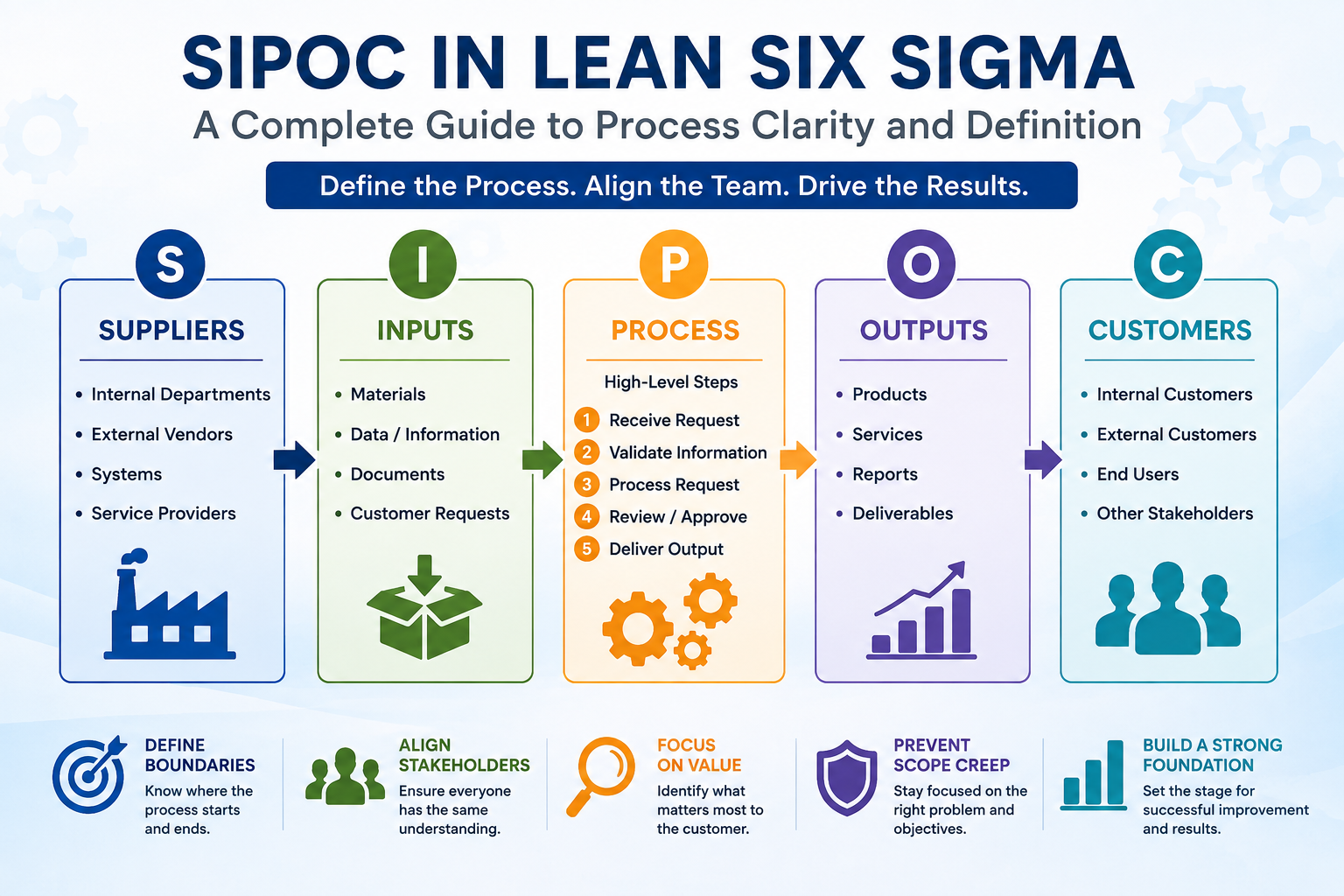
SIPOC stands for:
- Suppliers
- Inputs
- Process
- Outputs
- Customers
It is a high-level process mapping tool that provides a complete overview of how a process works.
Unlike detailed flowcharts, SIPOC focuses on clarity rather than complexity. It captures the essential elements of a process on a single page.
It helps answer key questions:
- Where does the process start and end?
- What inputs are required?
- What outputs are generated?
- Who are the customers?
The real strength of SIPOC lies in alignment. When teams create a SIPOC together, differences in understanding become visible, and clarity emerges.
Image Suggestion (Place here)
SIPOC diagram showing Suppliers → Inputs → Process → Outputs → Customers
Alt Text: SIPOC diagram for process mapping in Lean Six Sigma
H2: Why SIPOC Is Critical in Lean Six Sigma Projects
In the DMAIC methodology, the Define phase sets the foundation for the entire project.
If this phase is weak, the entire project suffers.
SIPOC plays a key role here by:
- Defining process boundaries
- Aligning stakeholders
- Preventing scope creep
- Ensuring focus on the right problem
Without SIPOC, teams often face:
- Confusion about scope
- Misaligned expectations
- Incorrect data collection
- Ineffective solutions
SIPOC acts as a risk prevention tool, ensuring that improvement efforts start on the right path.

H2: Why SIPOC Is Critical in Lean Six Sigma Projects
In the DMAIC methodology, the Define phase sets the foundation for the entire project.
If this phase is weak, the entire project suffers.
SIPOC plays a key role here by:
- Defining process boundaries
- Aligning stakeholders
- Preventing scope creep
- Ensuring focus on the right problem
Without SIPOC, teams often face:
- Confusion about scope
- Misaligned expectations
- Incorrect data collection
- Ineffective solutions
SIPOC acts as a risk prevention tool, ensuring that improvement efforts start on the right path.
H2: Understanding the Five Elements of SIPOC
To use SIPOC effectively, it is important to understand each component clearly.
H3: Suppliers
Suppliers are the sources that provide inputs to the process.
They can include:
- Internal departments
- External vendors
- Systems or databases
- Service providers
Identifying suppliers helps uncover upstream dependencies that may impact process performance.
H3: Inputs
Inputs are the resources required for the process to function.
These may include:
- Raw materials
- Data or information
- Customer requests
- Documents
Poor-quality inputs often lead to poor outputs, making this step critical.
H3: Process
This section defines the high-level steps involved in the process.
Typically, it includes 5–7 major steps to maintain clarity.
For example:
- Receive request
- Validate information
- Process request
- Deliver output
The focus is on structure, not detailed steps.
H3: Outputs
Outputs are the results produced by the process.
They can be:
- Products
- Services
- Reports
- Deliverables
Clearly defining outputs ensures measurable results.
H3: Customers
Customers are the recipients of the outputs.
They can be:
- External clients
- Internal teams
- End users
Understanding customers ensures that the process delivers value, not just efficiency.
H2: How to Create a SIPOC Diagram (Step-by-Step)
Creating a SIPOC diagram should be a collaborative activity involving cross-functional teams.
Follow these steps:
Step 1: Define Process Boundaries
Clearly identify where the process starts and ends.
Without clear boundaries, the process becomes difficult to manage.
Step 2: Identify High-Level Process Steps
List 5–7 key steps that define the process.
Avoid going into too much detail at this stage.
Step 3: Define Outputs
Ask:
- What does this process produce?
- Who receives it?
This helps clarify value delivery.
Step 4: Identify Customers
Determine who benefits from the outputs.
This ensures customer-focused improvement.
Step 5: Identify Inputs
List the resources required to execute the process.
Step 6: Identify Suppliers
Finally, identify who provides the inputs.
💡 Tip: Although SIPOC reads left to right, it is often easier to build it starting from the Process column.
Image Suggestion (Place here)
Flowchart showing SIPOC creation steps
Alt Text: Steps to create a SIPOC diagram in Lean Six Sigma
H2: Real-World Example – SIPOC for Pizza Manufacturing
Let’s consider a simple example.
Suppliers
Ingredient vendors (flour, cheese, vegetables)
Inputs
Raw materials, recipes, order details
Process
Preparation → Assembly → Baking → Inspection → Packaging
Outputs
Ready-to-deliver pizza
Customers
End customers or retail outlets
This example highlights how SIPOC provides a clear and structured overview of the process.
Image Suggestion (Place here)
SIPOC diagram for pizza manufacturing process
Alt Text: SIPOC example for manufacturing process
H2: Common Mistakes in SIPOC Creation
Despite its simplicity, SIPOC is often misused.
- Adding Too Much Detail
SIPOC is a high-level tool, not a detailed process map.
- Poorly Defined Boundaries
Unclear start and end points lead to confusion.
- Lack of Stakeholder Involvement
Creating SIPOC in isolation results in incomplete understanding.
- Treating It as a Formality
SIPOC should be used for alignment, not just documentation.
H2: Strategic Benefits of SIPOC
SIPOC offers several organizational benefits:
- Improves cross-functional communication
- Clarifies roles and responsibilities
- Identifies dependencies
- Enables better decision-making
- Builds a structured improvement culture
For leadership, SIPOC provides a simple view of complex processes.
Understanding SIPOC can help learners apply concepts covered in Lean Six Sigma Green Belt Training Chennai to real-world process improvement projects.