
Six Sigma Project Selection: How to Choose the Right Project for Maximum Business Impact-Part -1
Introduction: Why Project Selection Decides the Success of Six Sigma
Many organizations invest in Lean Six Sigma training, certifications, and tools, yet struggle to see meaningful business impact. The problem is rarely with the methodology itself. In most failed deployments, the real root cause lies much earlier — choosing the wrong project.
Six Sigma is a powerful, data-driven methodology designed to solve complex, chronic performance problems. However, when applied to the wrong type of problem, it becomes slow, over-engineered, and frustrating for stakeholders. This leads to common complaints such as:
- “Six Sigma takes too much time”
- “The business doesn’t have patience for DMAIC”
- “Our teams lose interest midway”
In reality, Six Sigma fails when it is used on problems that never needed Six Sigma in the first place.
This article explains how to select the right Six Sigma projects using internationally accepted best practices and practitioner wisdom. If you are a Quality Leader, Black Belt, Green Belt, or business sponsor, mastering project selection will dramatically increase your success rate, stakeholder buy-in, and return on investment (ROI).
The Hidden Cost of Poor Project Selection
Choosing the wrong project has consequences beyond just project failure. Poor selection leads to:
- Wasted Belt effort and burnout
- Loss of leadership confidence in Six Sigma
- Teams seeing Six Sigma as “theory-heavy”
- Delayed business results
- Poor certification project outcomes
- Resistance to future improvement initiatives
On the other hand, the right project creates momentum.
One well-chosen project can:
- Deliver measurable financial impact
- Improve customer experience
- Build leadership trust
- Create internal advocates for Six Sigma
- Establish Six Sigma as a business enabler
Project selection is therefore not a tactical activity — it is a strategic leadership decision.
Core Criteria for Selecting the Right Six Sigma Project
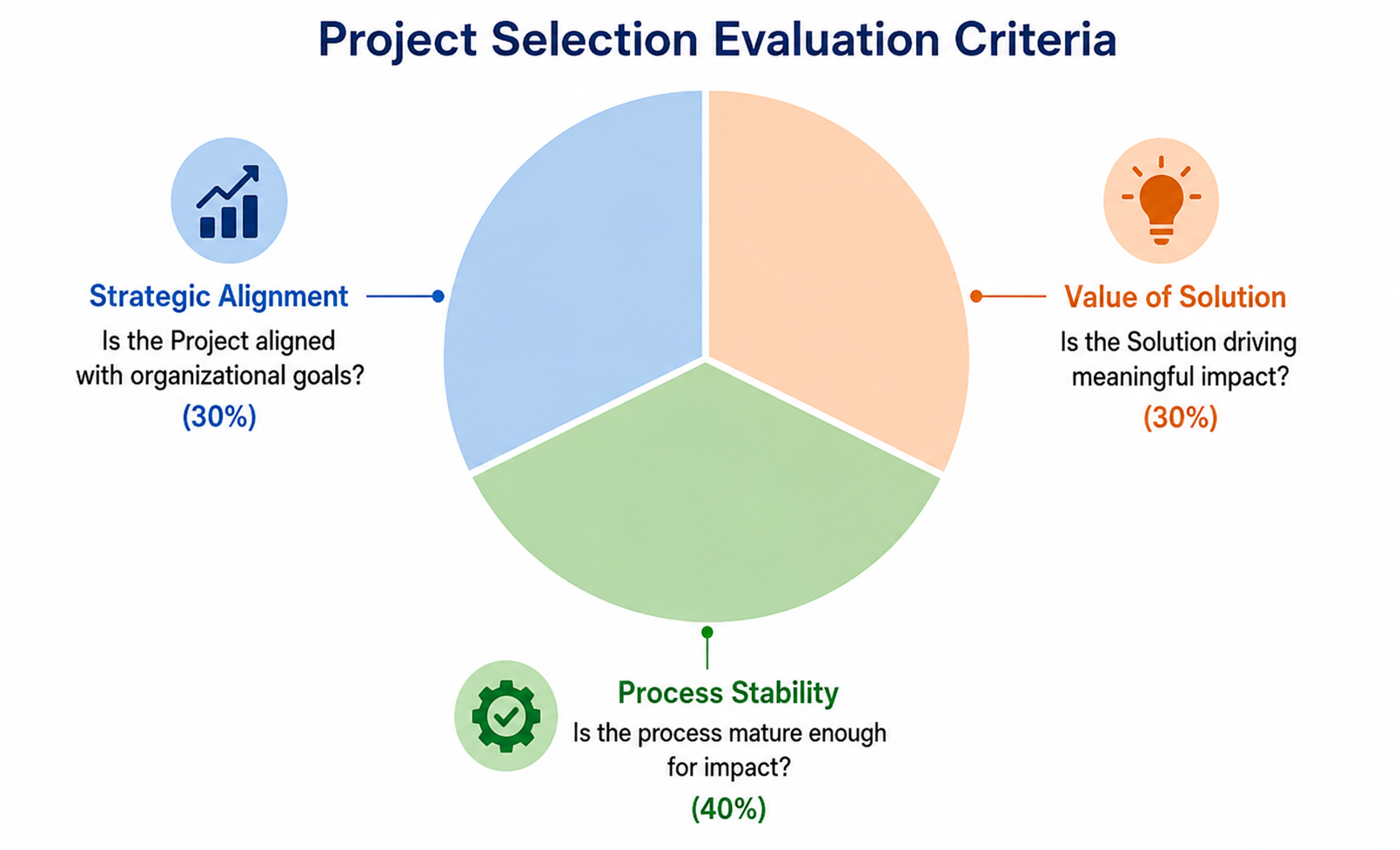
1️⃣ Strategic Alignment: Is the Project Aligned with Organizational Goals?
The first and most important criterion is alignment with business strategy.
A Six Sigma project must clearly connect to what the organization is trying to achieve.
Ask these questions:
- Does this project support revenue growth, cost reduction, customer satisfaction, or risk reduction?
- Does it link to leadership priorities, KPIs, or business OKRs?
- Can leadership see its relevance in boardroom discussions?
Projects that do not align with strategy often fail because:
- They receive low management support
- Stakeholders see them as “side projects”
- Benefits are difficult to prioritize
- Teams struggle to get data or cooperation
Best Practice:
Map every Six Sigma project to at least one strategic objective such as:
- Customer Experience (NPS, CSAT, complaints)
- Cost of Poor Quality (rework, scrap, refunds)
- Delivery performance (TAT, SLA, delays)
- Compliance, safety, or regulatory risk
When Six Sigma speaks the language of business strategy, leadership listens.
2️⃣ Process Stability: Is the Process Mature Enough for DMAIC?
Six Sigma DMAIC works best when the process is stable and running long enough to generate meaningful data.
If a process is brand new, under design, or constantly changing, DMAIC will struggle because:
- Baseline performance is unclear
- Data patterns are unstable
- Root causes keep shifting
- Improvements cannot be sustained
For mature processes running for at least 6–12 months, variation patterns emerge. These patterns allow Six Sigma tools such as control charts, Pareto analysis, hypothesis testing, and root cause analysis to work effectively.
Key Guideline:
- Existing process with performance variation → DMAIC (Six Sigma)
- New process or product design → DFSS (Design for Six Sigma)
Trying to fix an unstable process with DMAIC is like trying to improve the accuracy of a machine that is still being assembled.