
The Evolution of PMP: From Traditional Project Management to Modern Leadership-Part-1
Introduction: Project Management Professional (PMP) Didn’t Appear Overnight — It Grew with the Real World
Today, PMP is often seen as the “gold standard” in project management certification.
But PMP didn’t become globally respected overnight.
It evolved.
It changed with the world.
It adapted as industries changed.
It matured as projects became more complex.
Behind every version of PMP is a simple truth:
The way we manage work keeps changing. PMP had to grow up with it.
If you’re preparing for PMP today, or even just curious about how it became what it is now, understanding its evolution gives you confidence that you’re not learning outdated theory—you’re learning a living framework shaped by real professionals, real projects, and real failures.
Let’s walk through how PMP evolved, why it keeps changing, and what that means for your career today.

Why PMP Needed to Evolve in the First Place

If PMP had stayed stuck in old ways, it would have become irrelevant.
Instead, PMI chose to evolve PMP continuously—aligning it with how work actually happens.
That’s why PMP today looks very different from PMP of the early days.
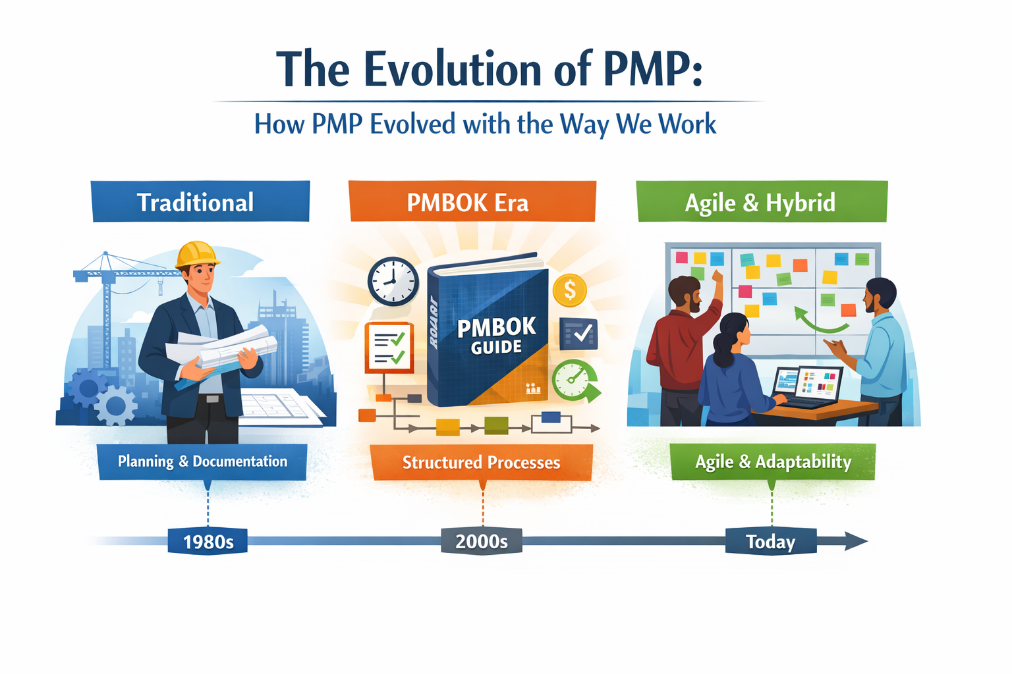
The Early Days of PMP: When Structure Was the Hero

This made sense for that era:
- Large construction projects
- Infrastructure
- Defense
- Manufacturing
- Engineering programs
This version of PMP helped professionalize project management as a discipline.
It gave structure to what was earlier informal and experience-driven.
In many ways, this was when Project Management Professional (PMP) grew up as a profession.
The PMBOK Era: Standardising How Projects Are Managed
As PMP matured, PMI introduced PMBOK (Project Management Body of Knowledge) as a reference framework.
PMBOK became the backbone of PMP learning.

For many professionals, PMBOK brought clarity:
“This is what good project management looks like.”
But over time, cracks started showing.
Projects in software, digital products, and startups didn’t fit neatly into heavy upfront planning models. The real world was becoming more fluid.
PMP had to change again.
The Agile Wave: When Project Management Professional (PMP) Started Listening to Reality
As Agile methods gained popularity, especially in IT and product development, a new reality emerged:
Projects were no longer fully predictable.
Requirements evolved.
Customer feedback arrived early and often.
Teams worked in iterations.
Traditional PMP thinking—plan everything upfront—didn’t fully work here.
Instead of resisting Agile, PMI did something smart:
It embraced agile thinking into PMP.
Over time, PMP started including the following:

From Process-Focused to People-Focused PMP
One of the most important shifts in PMP history is the move from process-heavy to people-centric leadership.

Why this shift?
Because projects don’t fail due to lack of templates.
They fail due to:
- Misaligned stakeholders
- Poor communication
- Low trust
- Weak leadership
- Change resistance
Modern PMP recognizes this human side of project management.
This makes Project Management Professional (PMP) more relevant not just to project managers but to anyone leading people and outcomes.


